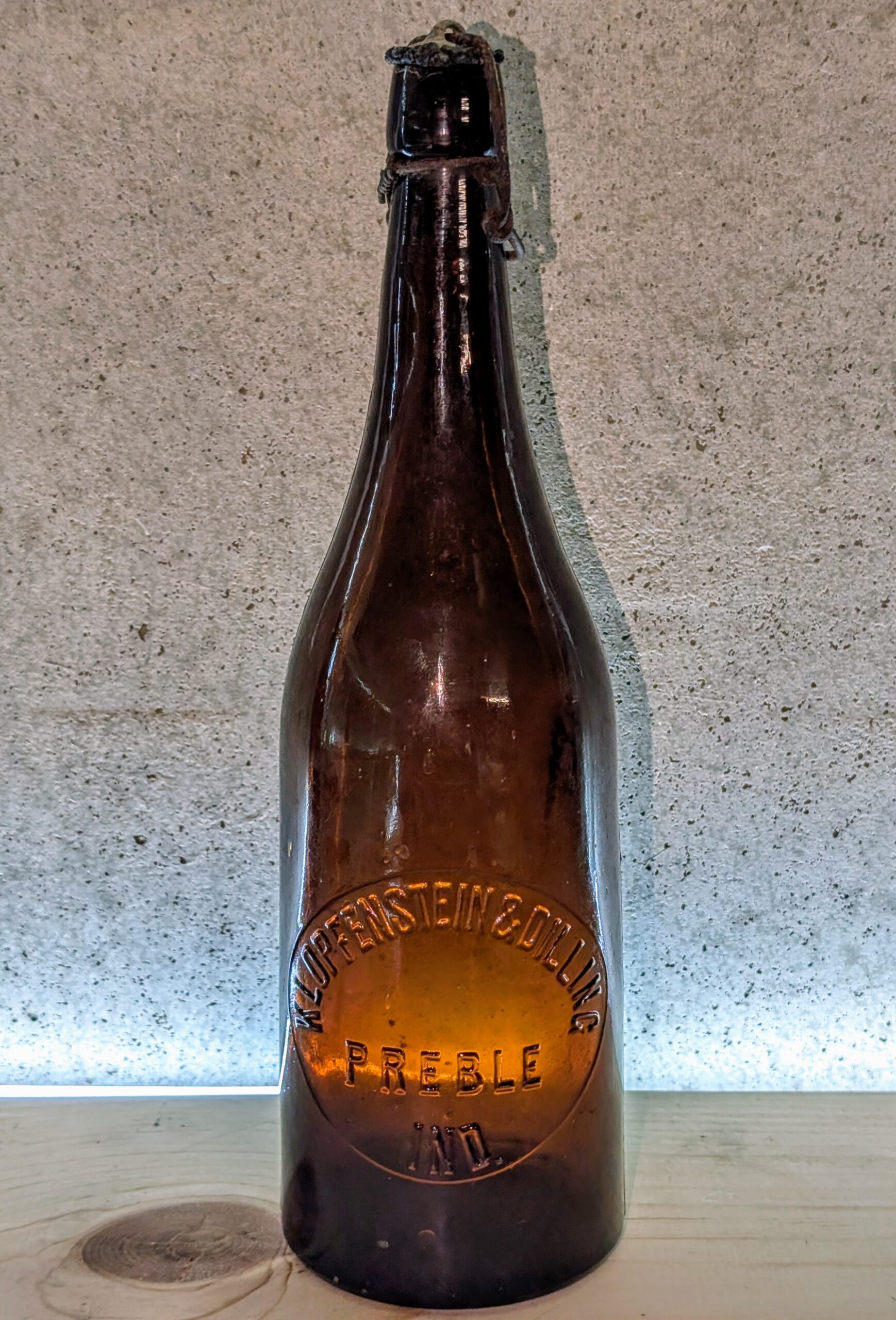
Here’s an example of a bottle from a place many may have never heard of in Indiana. Preble is an unincorporated community little more than a dot on the map, located at the very southern end of Preble Township in Adams County, about 5 miles west of Decatur, platted in 1884. Adams County, IN is home to one of the largest Swiss Amish communities in the United States. Today, Preble remains a quiet rural crossroads surrounded by farmland with an estimated population of fewer than 100 residents according to the U.S. Census Bureau (2026 data), not to be confused with the population of the Preble Township in Adams County. Preble does have its own post office! This one may very well take the reins as the smallest town in the state known to have bottled beer in an embossed bottle.
Preble is listed in the 1890 Indiana Gazetteer “Preble. Rural post office and station on the Chicago and Atlantic Railway in township of the same name, in Adams County, five miles west of Decatur the county seat and banking town. Population 65. Wells Fargo Express. J.F. Eggers, postmaster. Merchants; J.F. Eggers, general store; A.H. Gehler, railway and express agent; Albert Huser and Co. saw mill; Werling and Dilling, tile manufactures.”
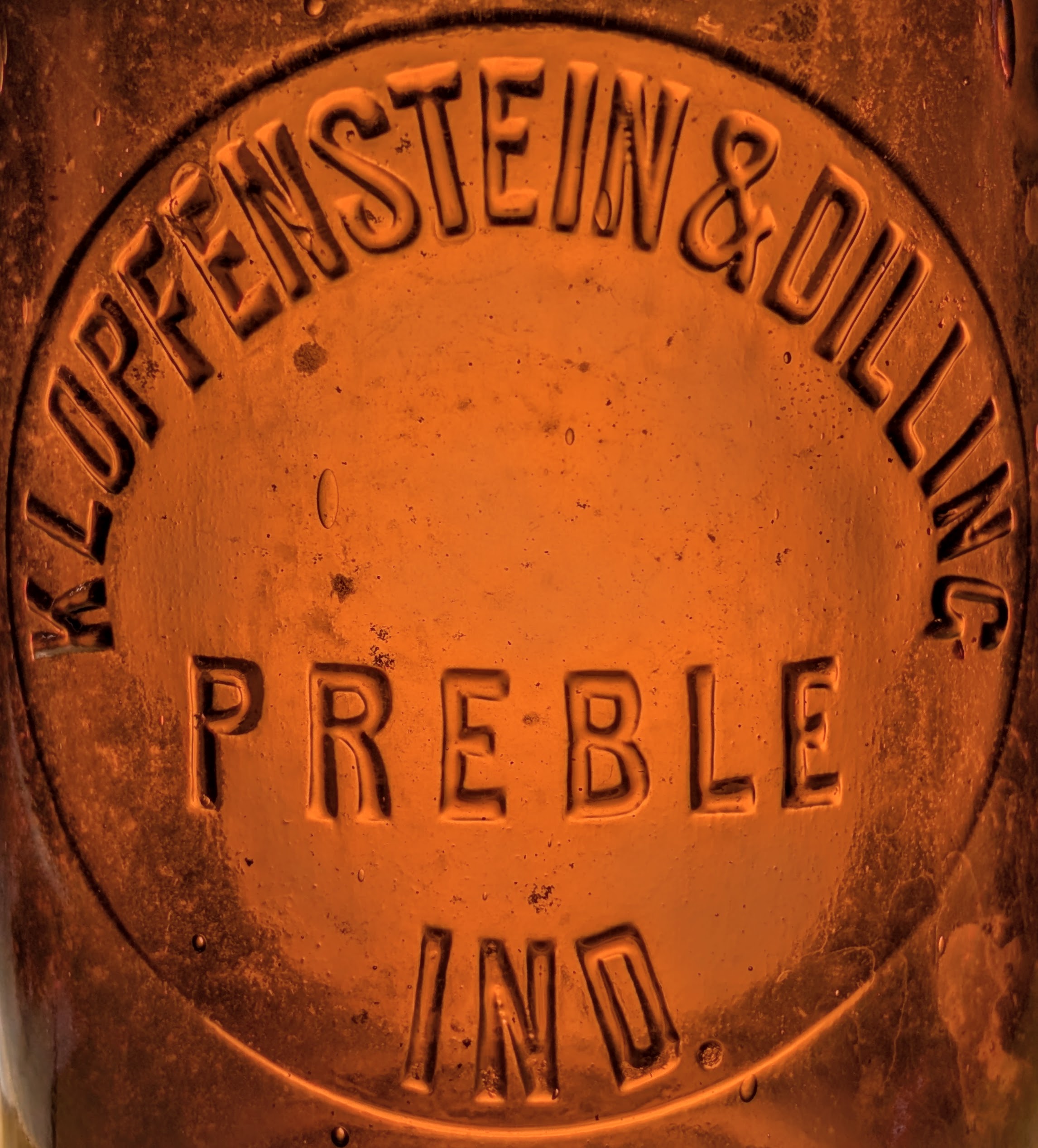
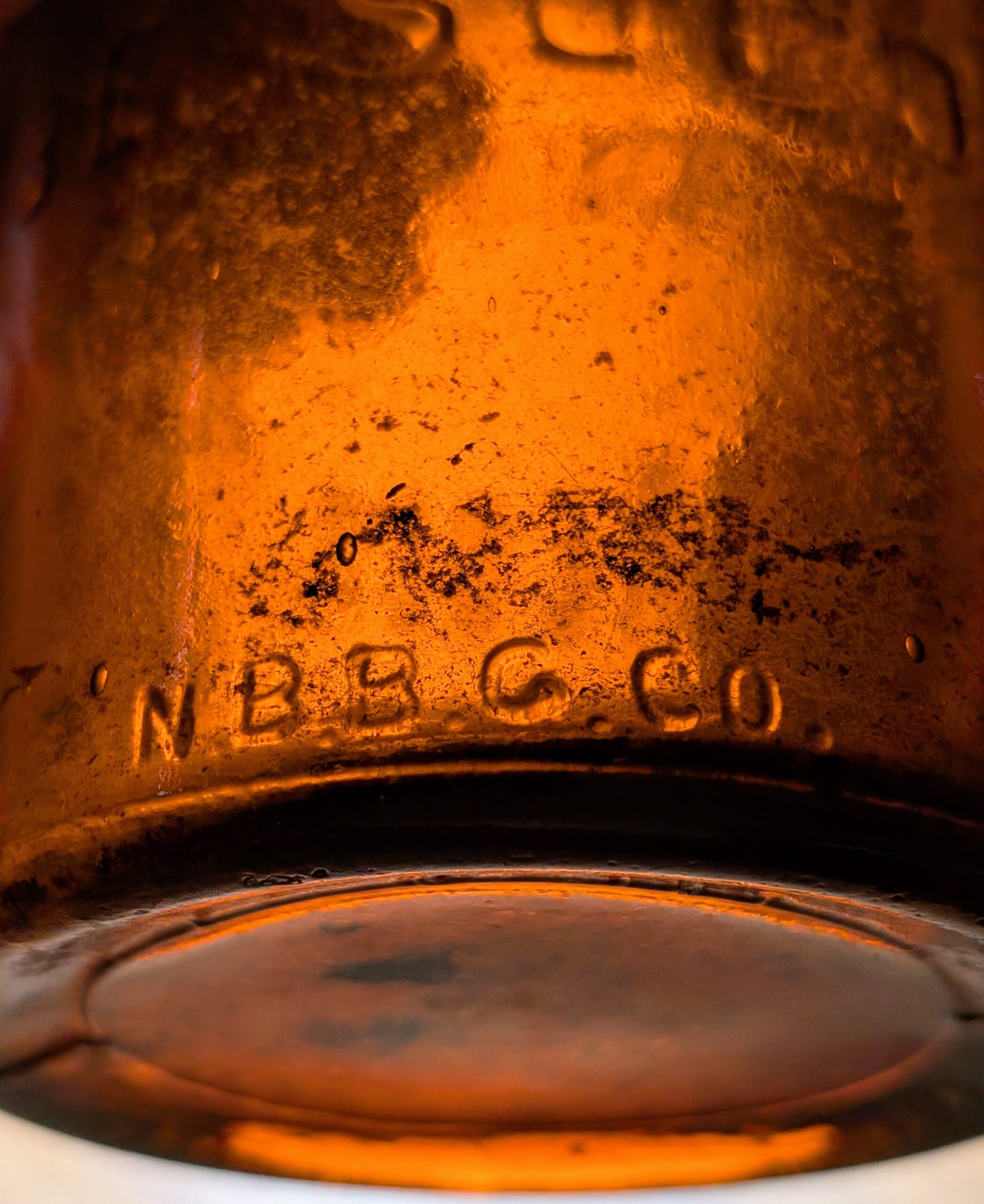
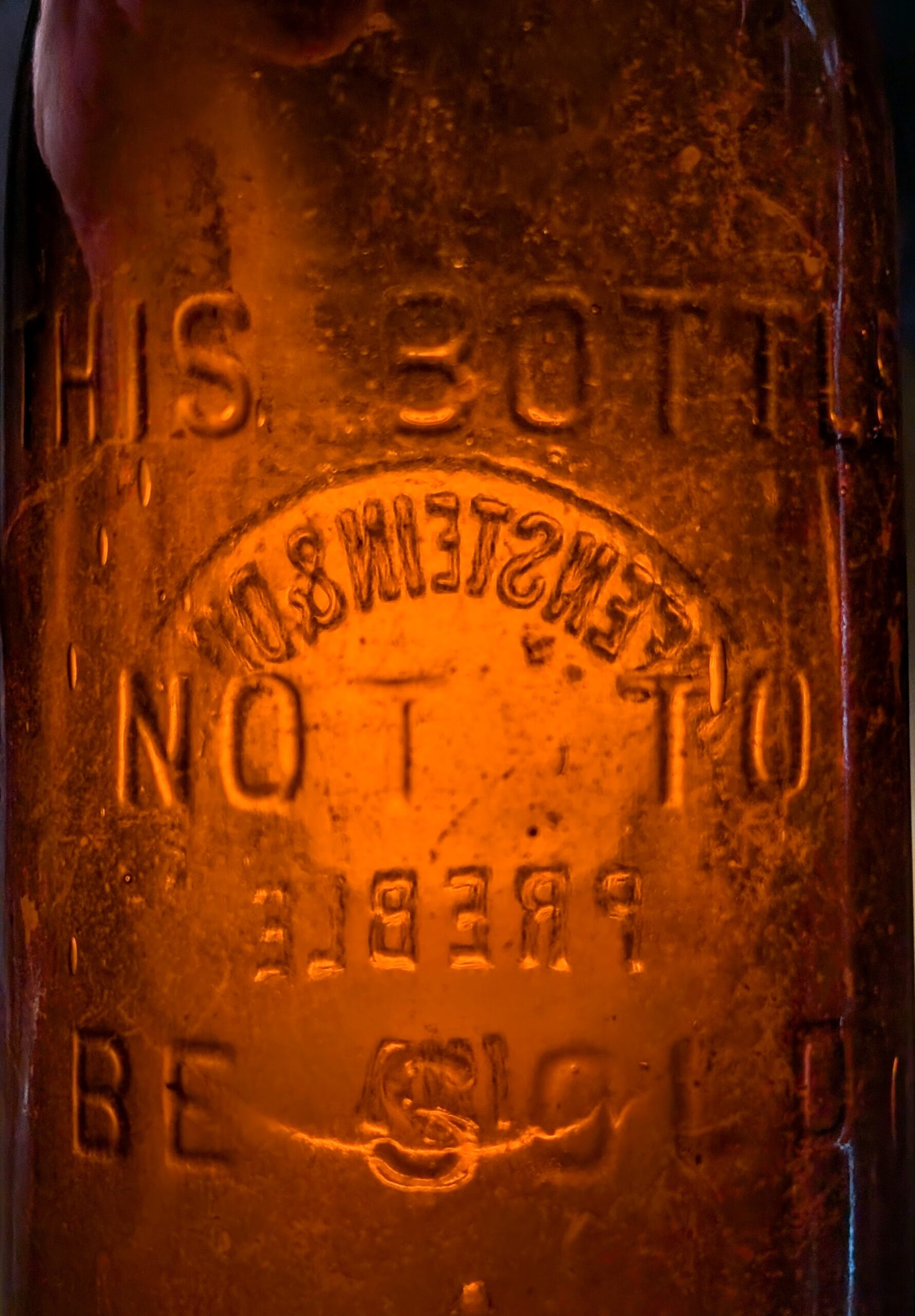
The bottle is embossed with the surnames Klopfenstein and Dilling, referring to Jeff Klopfenstein and David J. Dilling. The bottles are considered very hard to find.
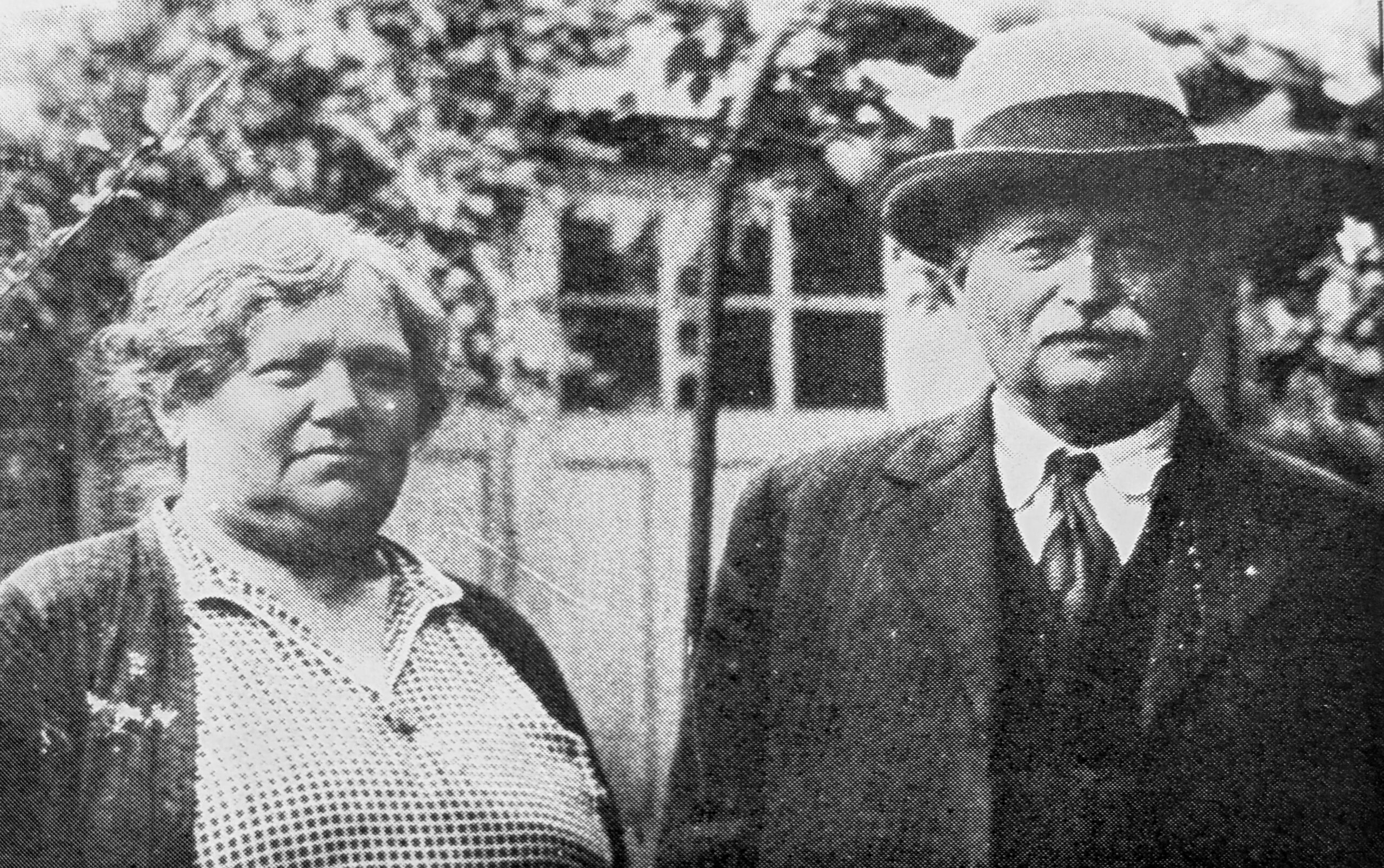
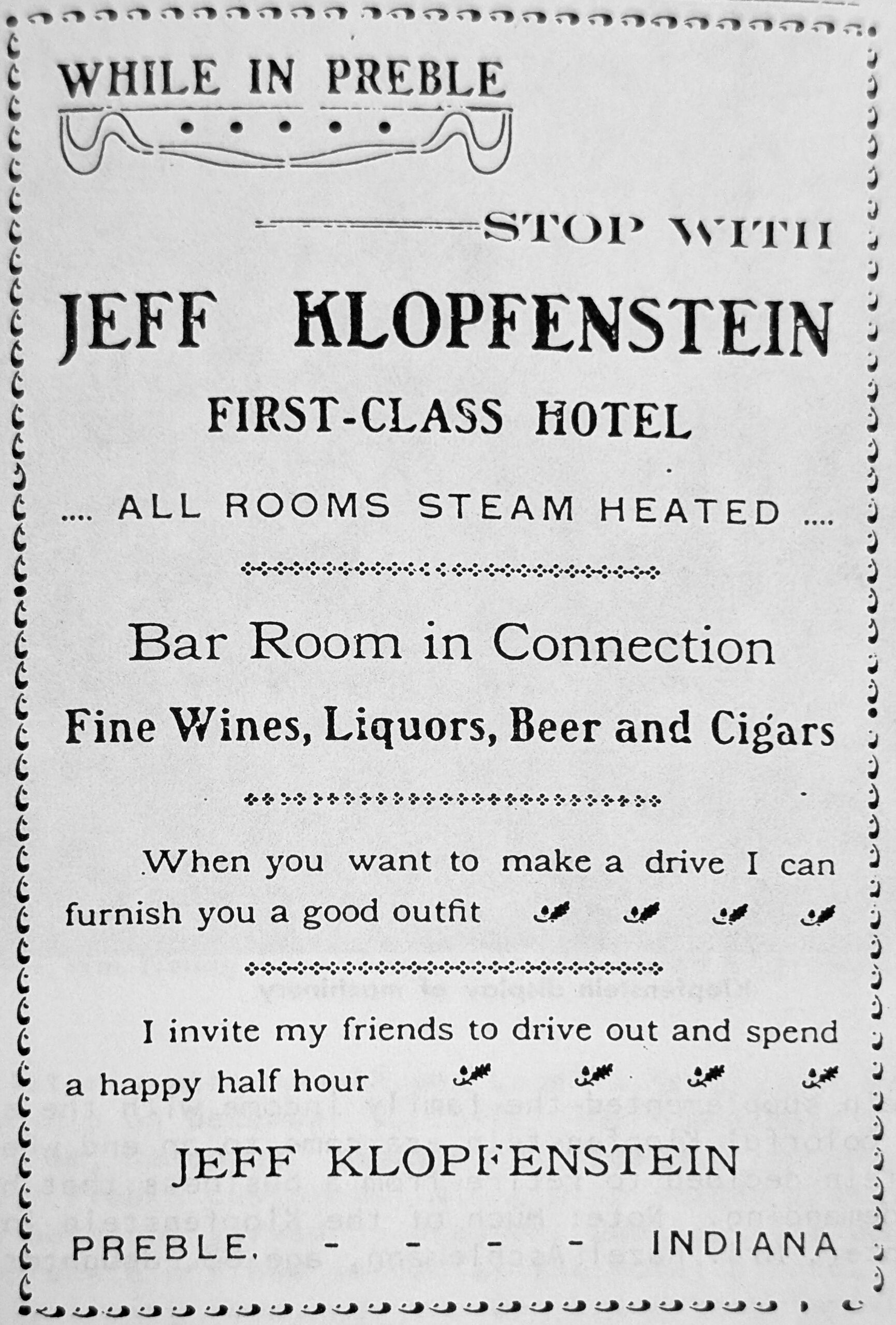
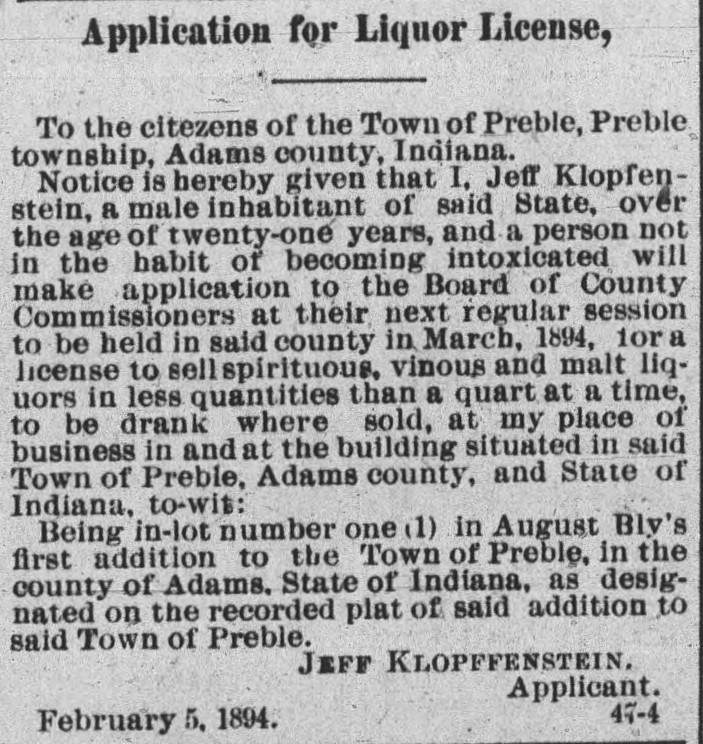
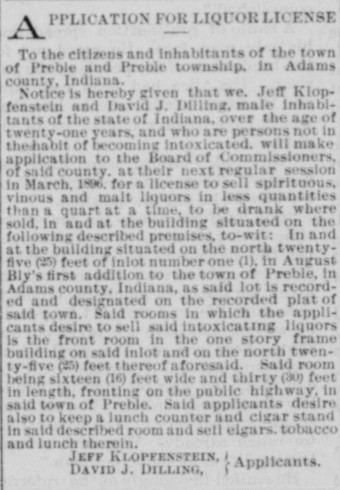
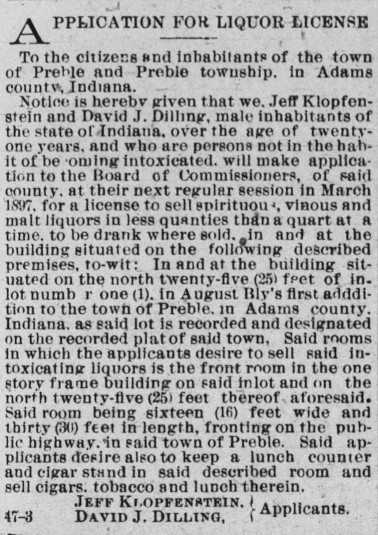
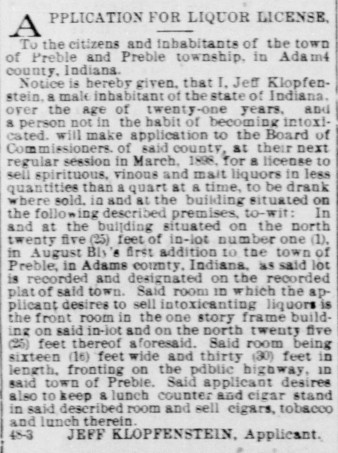
We do not know exactly what year they began business together, but on February 5, 1894, Jeff applied for a liquor license on his own. We could not find any liquor license for David that year. We also could not locate any liquor licenses in 1895; however, in 1896 and 1897, both Jeff and David applied for a license together. In 1898, Jeff applied solely, and David was no longer mentioned on the license. According to Preble History (Preble Centennial Committee, 1984), “On March 25, 1898, Jeff Klopfenstein became the sole owner of the saloon.” Based on this information, it appears they likely bottled together only from about 1896 to 1898. We do not know if Jeff Klopfenstein ever had his own embossed beer bottle.
Jeff Klopfenstein
He was born on March 7, 1866 in Wells County, Indiana (the county east of Adams). According to U.S. Census records, his father, Jacob, was born in France and his mother, Elisabeth, was born in Switzerland, with Jacob’s birthplace listed as France in the 1860 census. However, Jacob’s 1880 census entry instead records his birthplace as Switzerland. That discrepancy is understandable, as the last name Klopfenstein is strongly associated with Swiss German families, particularly those originating in the Canton of Bern region of Switzerland. In 19th-century census records, immigrants from French-speaking or border regions of Switzerland were sometimes recorded as being born in France, depending on the language spoken, cultural identity claimed, or the interpretation of the census enumerator.
According to the Decatur Daily Democrat (October 3, 1916), Jeff sold his Preble saloon to Fort Wayne saloon businessman William Freitag.
Jeff’s obituary states that he died on March 2, 1934, in Fort Wayne. He moved there from Preble around 1917. The obituary also noted that he had operated a general store and a saloon known locally as “Jeff’s Place” in Preble.
David J. Dilling
He was born on June 26, 1862, in Martinsburg, Pennsylvania, the son of Casper and Margaret Johnson Dilling, both of whom were also born in Pennsylvania. He moved to Indiana in 1881 and resided in Preble Township until 1929, when he relocated to Fort Wayne. David served as an Adams County commissioner for eleven years. The 1900 and 1910 U.S. Census records list his occupation as a farmer. He died on May 4, 1941, at his home in Fort Wayne from heart disease.
If you have any photos or more information, we would love to document them! We’ll also add more as we find it.
Main Sources
Preble History. Preble Centennial Committee, 1984. Frederick W. Bieberich and Irene Ewell Bieberich.
Snow, J. F. Snow’s History of Adams County, Indiana. Indianapolis: B. F. Bowen, 1907.
Klopfenstein Family Record: The Chronology of the Descendants of Michael Klopfenstein, 1757–1925. Decatur, Indiana: J. H. Klopfenstein, 1926. (Notes that Jacob Klopfenstein was born in France.)
Decatur Democrat and Decatur Daily Democrat (various issues).
See Articles tab for full newspaper transcriptions before 1930.
1) The Decatur Democrat — June 28, 1900, p. 1
Jeff Klopfenstein, the hustling Preble business man, announces that the 124th anniversary of the greatest nation on earth will be celebrated by the patriotic people of Preble and vicinity on the evening of Tuesday, July 3.
The amusements will begin at five o’clock and will consist of a display of fireworks, bicycle race, wheelbarrow race, potato race, fat man’s race, music. The citizens of Preble have been giving these entertainments on the evening before the Fourth annually for several years and this year will be bigger and better than ever.
2) The Decatur Democrat — December 6, 1906, p. 6
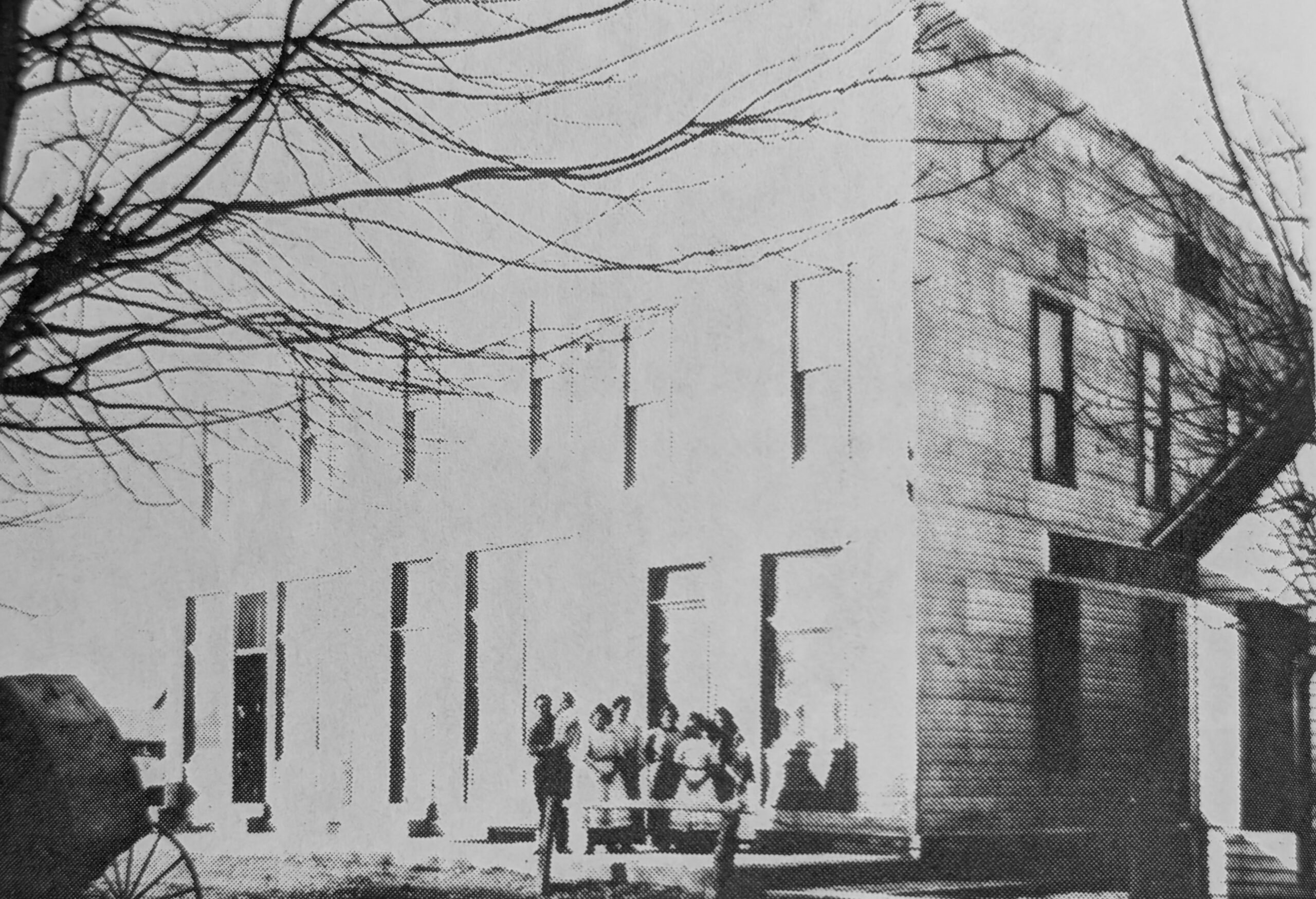
Jacob C. Miller of this city has been awarded the contract for the erection of Jeff Klopfenstein’s new hotel at Preble, and began work on the same today. It is to be a twenty-room building, modern and convenient in every respect and Mr. Klopfenstein will in no way be disappointed when the contract is completed.
3) The Decatur Daily Democrat — July 9, 1907, p. 1
Preble Booming
Lots of Business at That Little Town
Preble is a busy place. In a short time spent in that hustling burg Monday, a member of the Democrat household was at once impressed with the progress of the people there. Pretty and neat residences are scattered everywhere. Two new homes are under erection, and happiness and contentment was observed on every hand.
It is evident that commissioner David Werling is pretty much the whole thing in the business life of Preble. He has a beautiful home, a saw mill and tile mill, giving employment to a number of people, and is always perched on a front seat in any progressive movement, and such movements have been plenty during the past several years.
Coroner J. G. Grandstaff lives in Preble, where he enjoys the distinction of a practice that is both remunerative and a credit to his profession. He traverses a goodly section and as the boys say, is getting the candy.
The Standard Oil pumping station are building something all the time and is certainly a great industry. There are about eighty people draw substantial salaries from that plant. They now have sixteen tanks, holding 35,000 barrels each, and intend to build seven more. The valuation for taxation purpose figures near $150,000 and that is an item worth considering.
The Jeff Klopfenstein hotel is a commodious affair with thirty sleeping rooms, large dining room, office, barber shop and bar. He is housing about twenty regular boarders and doing the sort of business that makes a business man smile. His hotel building also contains a public hall, plenty large enough to accommodate two hundred people.
4) The Decatur Daily Democrat — April 2, 1909, p. 1
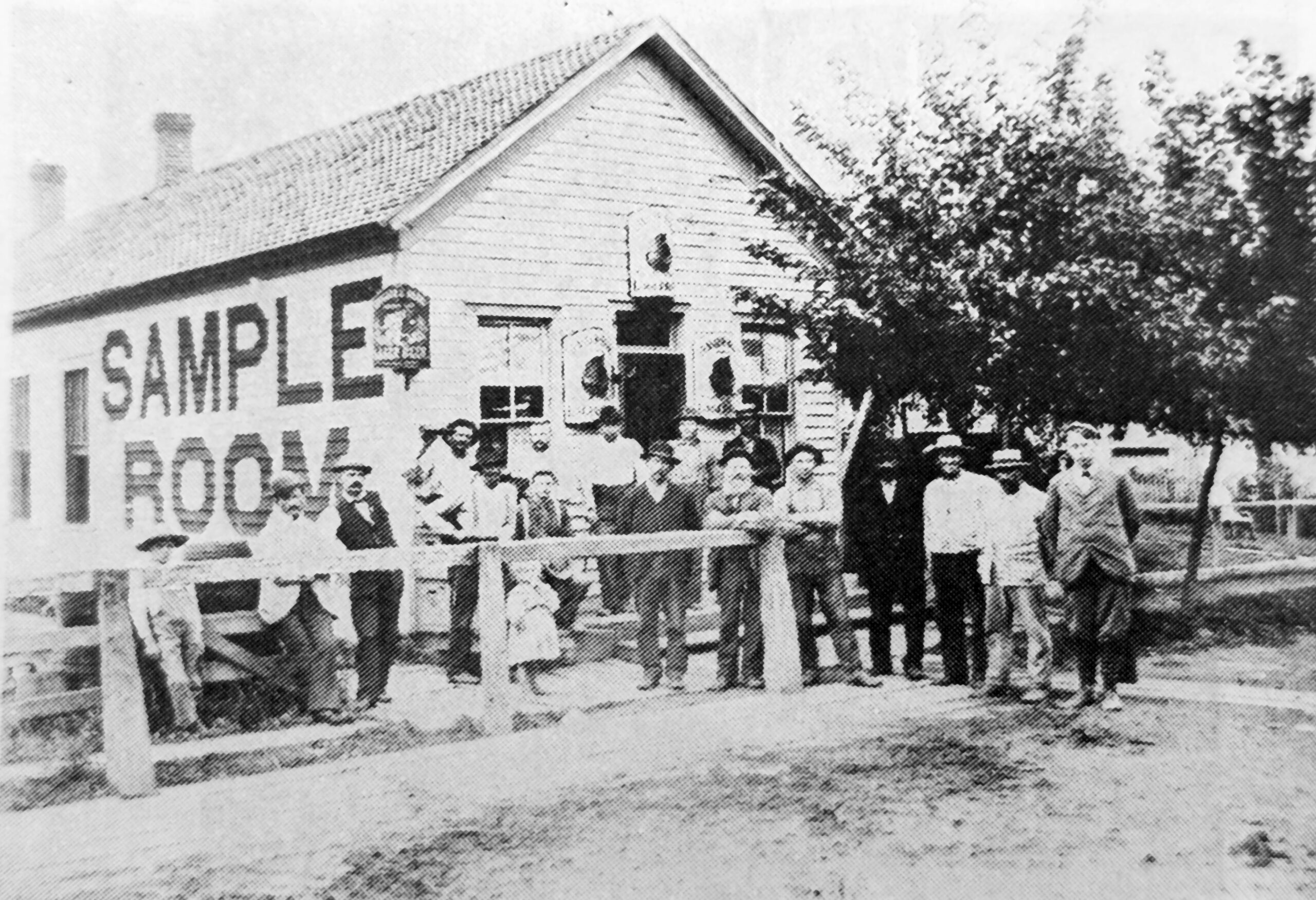
Among those who have figured conspicuously as promoters of the interest of Preble, is Jeff Klopfenstein, who sixteen years ago opened to the public a place of business in a building of small proportions. He did a thriving business, and to keep in pace with his rapidly increasing patronage, he built a beautiful building with all modern improvements a few years ago. This structure cost about $10,000, and it has every convenience known.
Mr. Klopfenstein immediately after the completion of the building, engaged in the hotel business, and he now owns a livery business, barber shop, meat shop, saloon and hotel.
5) The Indianapolis News — November 6, 1909, p. 2
Adams County Now “Dry”
Decatur, Ind., November 6. — The Nickel Plate, the last saloon in Adams county, operated by Joseph J. Tonnellier, has closed its doors. Tonnellier reaped a harvest the last week, having no competitor, as the saloon owned by Joseph Knapke closed Monday night.
The closing of the sixteen saloons in this city has been gradual. The buildings which were occupied by them are now occupied by substantial business firms.
Before the last saloon closed people drove from Berne, Geneva, Bluffton and Willshire, O., and returned to their homes with well filled suitcases and jugs, as this was their last chance to buy booze in this part of the state with the exception of Ft. Wayne, twenty-one miles north.
6) The Decatur Daily Democrat — May 31, 1910, p. 1
Preble Young Folks’ Club Entertained Large Number Friday Evening
At a Big Dance
Many from this city took advantage of the occasion — forty couples.
When Jeff Klopfenstein, at Preble, erected the new building he now occupies, and placed on the second story of the same the large and commodious dance hall he never once thought that the young people of that town and surrounding country could possibly crowd into one evening so much enjoyment as was felt on last Friday evening, when forty couples danced the light fantastic until the wee sma’ hours.
These social gatherings are fast coming into prominence in Preble, as on the last occasion over twenty persons were present from this city. Both square and round dances are indulged in and the next dance will be held on the evening of Thursday, June 9th. Jeff has proven himself the handy man and at all times refreshments are to be found in close proximity to the dance hall.
The Preble young folks invite all to attend their dances and it is quite probable that a large number from this city will take advantage of the occasion and will be in attendance. It is the intention of the Preble Young Folks’ Club to continue the dances through the summer, in case they can receive the support that is necessary for their continuance.
7) The Decatur Daily Democrat — October 3, 1916, p. 1
Saloon Is Sold
William Freitag, Ft. Wayne, Buys Jeff Klopfenstein Saloon
Possession Tonight
New Owner Has Been in Business Twenty Years at Fort Wayne.
Jeff’s is now no more — it’s “Bill’s.” Jeff Klopfenstein has sold his Preble saloon, building and all to William Freitag, of Fort Wayne and possession will be given to the new owner at the close of business tonight.
William Freitag, the new owner, has been in the saloon business in Fort Wayne for twenty years, doing business at Fairfield Avenue and Brackenridge during that entire period.
Mr. Freitag moved his household goods to Preble yesterday, bringing his residence in this county within the six months limit, by one day, for renewal purposes, as the license under which the saloon is being operated expires April 3rd, next.
Mr. Klopfenstein will move to his farm where he will rest for several months before determining definitely just what he will do.
Preble and Preble Township
1) Snow, J. F. (1907). Snow’s History of Adams County, Indiana. United States: B.F. Bowen.
The town of Preble is located about four miles directly west of Decatur and is the oil town of the county. This town was laid out and the plat recorded on the 14th day of November, 1884, by Daniel Hoffman and David Werling. Its original plat contained thirteen lots that are fifty by one hundred and fifty feet in size. Within the next three years David Werling laid out an addition to the town. A tile mill and a saw mill were located here soon after the town was begun. This village now has a large hotel, a good country store, a barber shop, butcher shop and saloon. The Standard Oil Company has extensive business interests here that require the presence of a large force of men, who permanently reside in Preble. The oil company’s pumping station buildings are about all brick. To the east and southeast is a town of great big boiler-iron tanks that resemble the tents of a show ground. This town has one brick residence, that of County Commissioner David Werling. The first steam circular saw mill operated in this township was located in section 27 and was owned by Frederick Peck and Lewis Fruchte. The estimated population of Preble township in 1907 is one thousand three hundred and eighty-five.
2) Directory of Indiana Manufacturers and Buyers’ Guide (1889)
PREBLE
Adams county, population 15, Chi & Atlantic RR, Exp at Decatur
Werling & Dilling, tile mnfrs
A Huser & Co, saw mill